
Website Development
Corporate sites, custom builds, and headless platforms engineered for Core Web Vitals, accessibility, and long-term maintainability.
- Core Web Vitals and PageSpeed targets written into the scope
- WCAG AA accessibility built in rather than retrofitted
- Content editable by your team without developer involvement
- Documented handover with no vendor lock-in

- Next.js
- React
- TypeScript
- WordPress
- Node.js
- Tailwind CSS
- Vercel
- MySQL
- 90+
- Target PageSpeed score
- WCAG AA
- Accessibility standard
- 4-8 wk
- Typical corporate build
What website development covers
A website is infrastructure, not a brochure. It has to load quickly on a mid-range phone over a poor connection, remain usable for people with assistive technology, stay editable by non-technical staff, and still be maintainable when the developer who built it has moved on.
Performance treated as a requirement
Core Web Vitals are a build requirement in our projects, not a post-launch clean-up. That means budgeting image weight and third-party scripts from the start, rendering critical content server-side, and measuring on representative devices rather than a developer laptop on office wi-fi.
Accessibility from the first component
We build to WCAG AA: semantic markup, keyboard operability, visible focus states, and sufficient colour contrast verified against real backgrounds. Retrofitting accessibility after launch costs several times more than building it in, and in many jurisdictions it is a legal obligation rather than a nicety.
Content ownership without developer bottlenecks
If every copy change needs a developer, the site goes stale. We model content properly in the CMS so your team can edit what they need, and lock down what should stay consistent. Structured fields beat a single freeform editor for anything that repeats.
Architecture chosen for your situation
We do not have a single default stack. A content-heavy marketing site with a small team is well served by well-configured WordPress. A site needing to feed a mobile app and multiple front ends benefits from a headless CMS with a Next.js front end. We explain the trade-offs, including running cost and hiring implications, before choosing.
Where website development makes the difference
The challenges we hear most often — and how we address each one.
The website looks dated and does not convert
Modern design, clear messaging, and strong calls to action turn visitors into enquiries.
Pages load slowly on mobile
Performance budgets and Core Web Vitals targets are part of every build.
Updating content needs a developer
An editor-friendly CMS lets your team change pages safely.
Search engines struggle to understand the site
Clean structure, metadata, and schema are built in from the start.
Our website development services
Each service has its own page covering scope, process, deliverables, and pricing tiers.
Website Maintenance & Support
Ongoing updates, security patching, backups, monitoring, and small changes under an agreed response time.
Learn moreWebsite Redesign & Migration
Redesigns and platform migrations executed without losing search rankings, traffic, or historical content.
Learn moreLanding Page Development
Fast, conversion-focused landing pages built for campaigns, with testing and analytics wired in from launch.
Learn moreWordPress Development
Custom WordPress themes, plugins, and headless WordPress builds — properly engineered rather than assembled from page builders.
Learn moreCorporate Website Development
Multi-stakeholder corporate sites with structured content governance, careers, investor sections, and multi-region support.
Learn moreCustom Website Development
Bespoke websites built from your requirements rather than adapted from a template, for organisations whose needs a theme cannot meet.
Learn moreWhat we deliver
Key features and capabilities of our website development work.
Custom design & build
Interfaces designed for your content and audience rather than adapted from a theme.
Headless & API-first options
Decoupled architecture where you need one content source feeding several front ends.
Structured content modelling
Repeating content modelled as fields so it stays consistent and reusable.
Performance budgeting
Image weight, script count, and render path controlled from the first commit.
Accessibility compliance
Semantic markup, keyboard paths, and contrast verified against WCAG AA.
Analytics & conversion tracking
Measurement configured at launch so you can see what the site actually does.
How the engagement runs
A clear sequence with a visible output at every step — so you always know where the project stands.
- 01
Discovery & scoping
We map requirements, users, integrations, and constraints, then agree scope and a fixed quote before development starts.
- 02
Architecture & design
Information architecture, UX flows, and technical architecture are agreed and prototyped before code is written.
- 03
Build & review
Development in reviewable increments, with a staging environment you can see and comment on throughout.
- 04
Launch & support
Performance and accessibility checks, documented handover, deployment, and an agreed support window after go-live.
Technologies & tools
Chosen per project for fit, maintainability, and your existing stack.
- Next.js
- React
- TypeScript
- WordPress
- Node.js
- Tailwind CSS
- Vercel
- MySQL
Industry applications
Sectors where we most often apply this service.
- E-Commerce & Retail
- SaaS & Technology
- Healthcare
- Real Estate
- Finance & FinTech
- Education
- Travel & Hospitality
- Professional Services
What's included at each level
Every engagement is scoped to your needs; these tiers show how scope typically grows.
| What's included | Starter | Growth | Enterprise |
|---|---|---|---|
| Discovery & technical scope | Included | Included | Included |
| Responsive design & build | Included | Included | Included |
| CMS setup & content modelling | Included | Included | Included |
| Performance & accessibility audit | Not included | Included | Included |
| Analytics & conversion tracking | Not included | Included | Included |
| Headless architecture & API layer | Not included | Not included | Included |
| Ongoing support & SLA | Not included | Not included | Included |
Delivered projects using this service
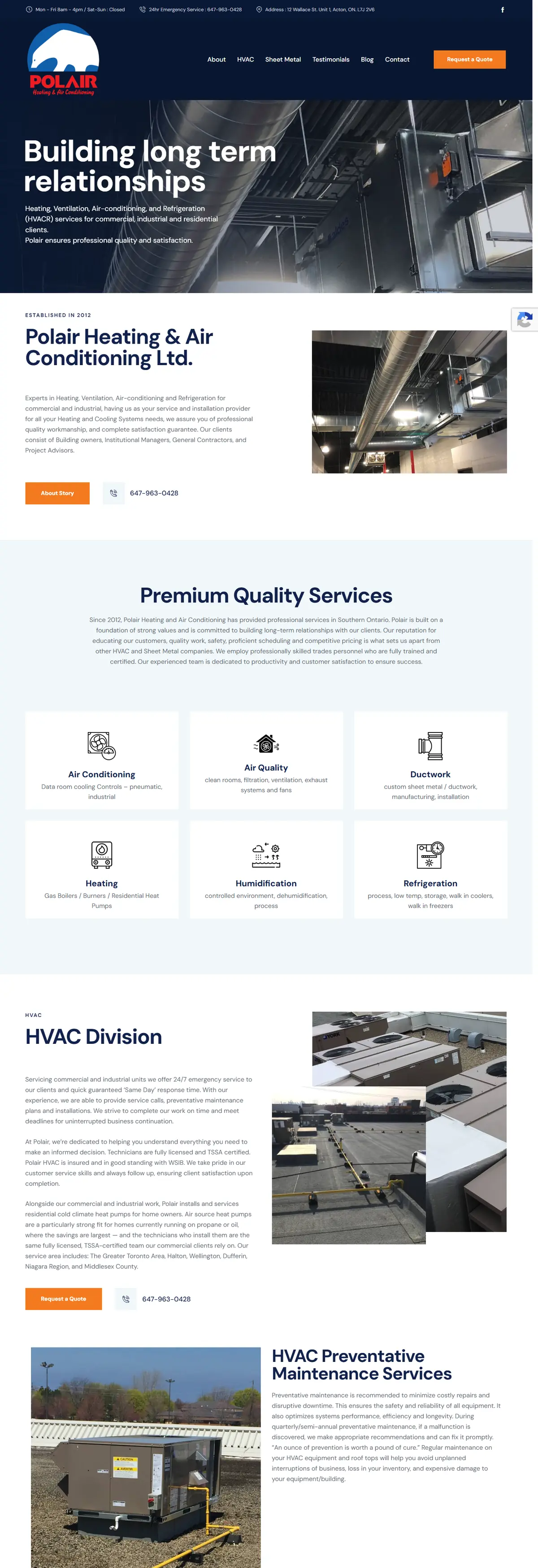
Polair Heating & Air Conditioning
Lead-generation website for a commercial and industrial HVACR contractor, organised around its service lines and quote requests.
- WordPress
- Elementor
- Slider Revolution
- Contact Form 7
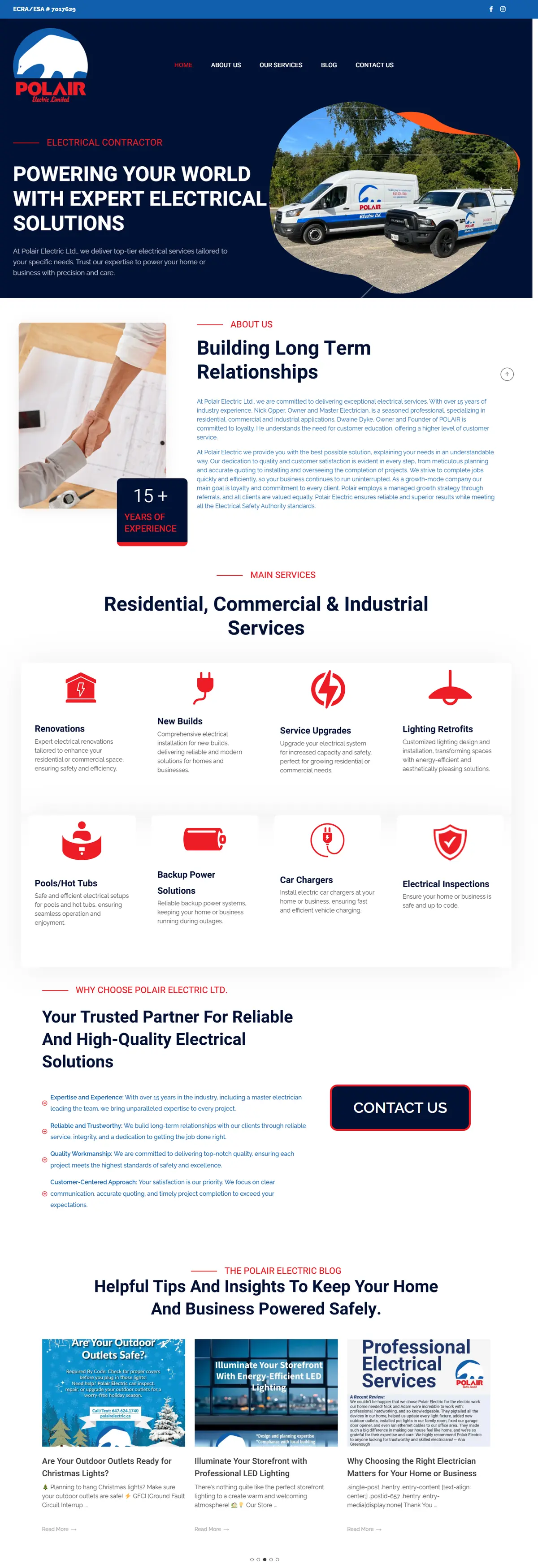
Polair Electric
Website for a licensed residential and commercial electrical contractor, built to establish trust and turn visitors into service calls.
- WordPress
- Elementor
- Contact Form 7
- Cloudflare
Website Development: common questions
How long does a website take?
A focused corporate site typically runs four to eight weeks from signed scope. Complex builds with integrations, migrations, or multi-language requirements run longer. We give a dated plan at scoping rather than a generic range.
WordPress or a custom build?
It depends on who maintains it and what it must do. WordPress is excellent for content-led sites with non-technical editors. A custom or headless build makes sense when you need multiple front ends, complex logic, or very high performance ceilings. We recommend based on your team, not our preference.
Do we own the code?
Yes. You get the repository, documentation, and all credentials. Nothing is held back as leverage, and any competent agency can pick it up.
Can you redesign without losing SEO?
Yes, and it needs deliberate planning: URL mapping, redirect strategy, metadata migration, and structured data parity. Most traffic losses after a redesign trace to redirects that were treated as an afterthought.
What happens after launch?
We include a support window for defects, then optional ongoing maintenance covering updates, security patching, backups, and monitoring.
Ready to talk about website development?
Tell us what you need. We reply within one business day with questions or a call slot — and a fixed, written proposal after.